What if You Could Save and Repeat Your Best Decisions
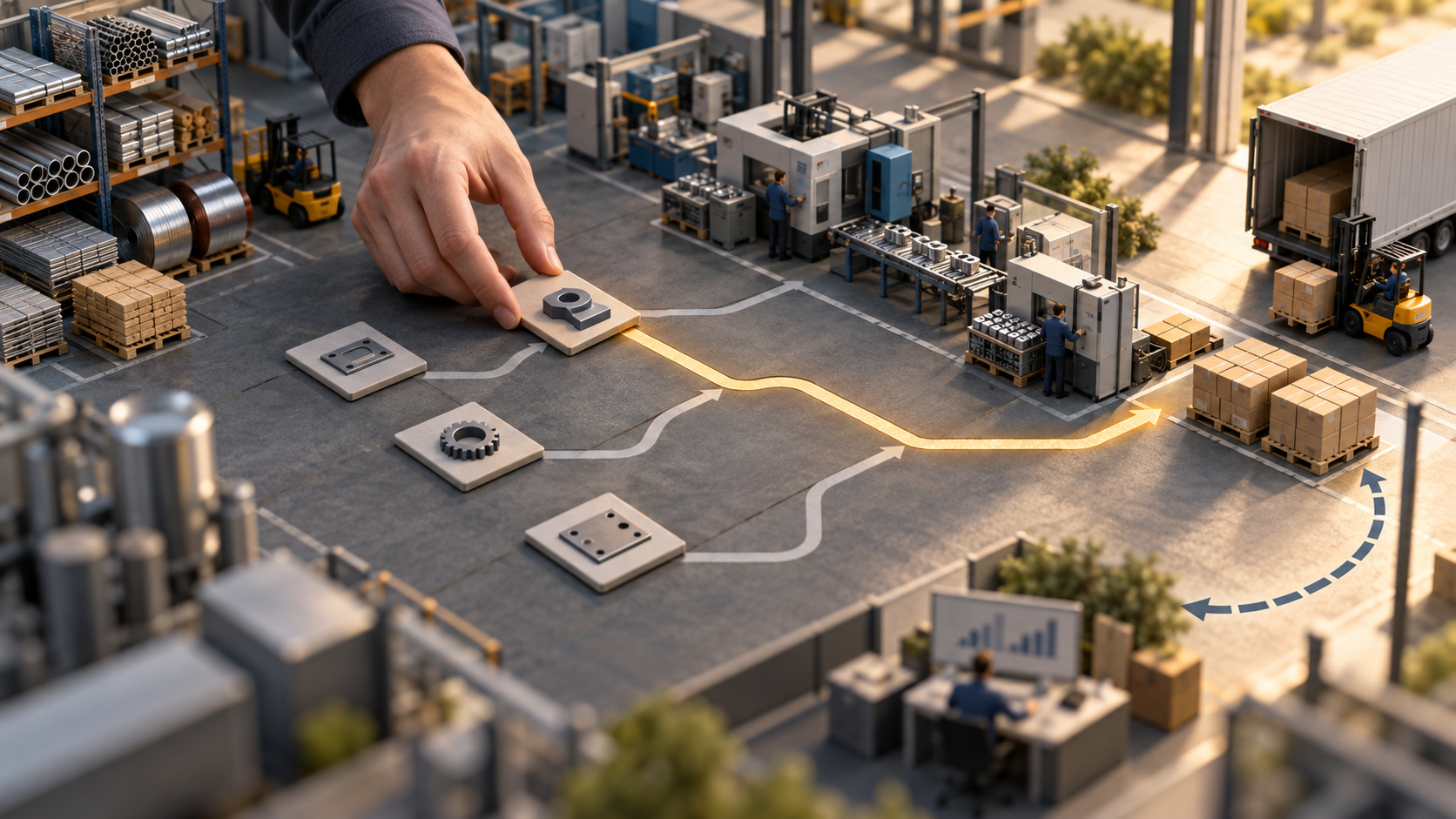
Think of a recent complex decision you had to make.
Perhaps you were figuring out how to meet customer orders with the materials and production capacity you had available. Changing suppliers or moving work between facilities could help, but either would affect your costs, your delivery dates, and other commitments you’d already made. You had to work through those consequences before you could choose what to do.
Keep that decision in mind for a moment, and let’s think about what went into it.
First, you gathered the data. Some came from your business systems and spreadsheets, and some came from conversations with people who knew what was actually happening.
Then you worked through the constraints: the rules, regulations, best practices, and practical limitations that determined which options were possible. A material might be available but unsuitable for the job. A machine might have capacity, but the person needed to run it might be working on something else. Understanding those details meant bringing the data together with people’s experience.
From there, you had to consider the trade-offs. Moving one order forward could push another back. Paying for faster delivery could protect a customer commitment but reduce your margin. So you were thinking through the concessions and knock-on effects, trying to work out what each choice would mean for the business.
This is what I think of as a large part of the planner’s job: predicting the future. When we make a decision, we’re imagining different future states. If I take this action, what is likely to happen? What if I do something else? We’re forecasting alternative scenarios, applying our judgment, and choosing the one that looks best given what we know.
Then you had to take action and get it done. After that came measurement: did the decision produce the result you expected? Ideally, you were checking as you went, making adjustments and learning from the difference between your prediction and the actual outcome. That’s optimization through iteration, and it’s how you get better at handling that kind of decision.
Now, where did you save all that?
When we ask this question, the answer is usually that it’s spread through a bunch of spreadsheets, conversations, and notes. And a lot of it is still in the person’s head. The business has the revised schedule or the purchase order, but the reasoning that connected the information to the action is much harder to find.
You know why you ruled out an option that looked good on paper. You remember the constraint someone mentioned in a conversation, and which assumption turned out to be wrong. If a colleague needed to make a similar decision tomorrow, they might have access to the same systems and still need to come back to you to understand how it all fits together.
So the ability to repeat that process still rests largely with you. You’ve solved the immediate problem, but making that experience useful to the rest of the organization is another piece of work.
Now imagine saving the whole process as a Decision Model. The data, constraints, trade-offs, predictions, actions, and measured results are connected, along with the human wisdom and judgment that shaped the decision. You have something you can run again, test against new conditions, and continue to improve. The purpose of saving it is to optimize the decision: work out which actions will produce better results, understand the trade-offs, and use what happens in practice to improve the next run.
For example, the next time you need to allocate production capacity, the orders and material availability will have changed. You can bring that new information into the model and compare the options without reconstructing the entire process. You can also use what you learned last time: perhaps a supplier’s lead time was too optimistic, or a changeover took longer than expected. Those lessons can be checked and incorporated into how you make the next decision.
This creates a continuous loop:
Data and rules → choices and trade-offs → prediction → action → measured result → learning and improvement
That’s Decision Optimization, and it’s what Kimaru does. Kimaru connects information from your existing systems, maps the rules and practices that shape the decision, and lets you simulate different actions before taking them. You apply your judgment, approve or adjust the recommendation, and Kimaru carries out the authorized steps and tracks the results. That whole process is saved as a reusable Decision Model, so you can keep optimizing the decision as conditions change.
Once you can run and improve that model, you can free yourself up to focus on the next big decision. Your colleagues can work from the same foundation, bringing their own experience to it rather than depending on you to explain everything from the beginning. The value extends beyond the time you personally save.
A single Decision Model helps you get better at a particular kind of decision, such as allocating production capacity. As you put more of those models to work across the business, you build Decision Capacity: the organization’s ability to consistently turn information, judgment, rules, and outcomes into better decisions.
Greater Decision Capacity improves profitability by helping the organization reduce avoidable costs, protect margin, increase revenue, and make better use of its resources. Measurement tells us how much value those decisions created and where. In the production example, that means comparing actual results with the previous approach: how much more we produced with the same capacity, how much we saved on expedites, and how much more margin we retained. Those results give us the evidence to improve the model further and apply what we’ve learned to the next decision.
Contact Us
So think back to the decision you started with. What would improving that decision mean for your business? Use the form below to tell us what you’re trying to achieve and what makes the decision difficult, and request a 30-minute conversation with our team. We’ll work through where Decision Optimization with Kimaru can help you reduce costs, increase revenue, or make better use of the resources you already have.