
From Just-in-Time to Just-in-Flight: Why Allied Defense Needs a New Nervous System
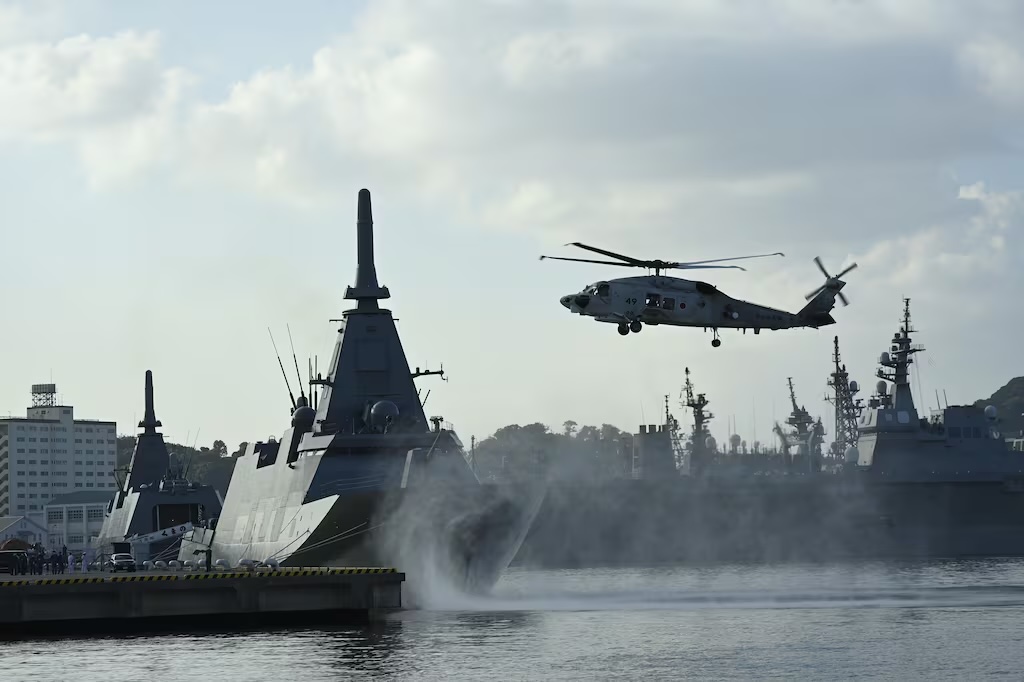
Japan just made its most aggressive geopolitical pivot in decades. By scrapping its postwar restrictions on lethal weapons exports, Tokyo is clearing the path to fully integrate its defense manufacturing with the US and Allied democracies.
But building export-grade defense hardware like warships, missiles, and next-gen fighters is not just a matter of assembly lines. To understand the gravity of this shift, you have to look at the invisible, hyper-complex web of logistics that feeds those factories. The supply chain assumptions that built the global manufacturing base no longer hold.
The Just-in-Time Era Is Over
For the last 40 years, global supply chains were built for the Just-in-Time era. The model was elegant in a stable world: minimize inventory, maximize cash efficiency, trust that components arrive on the day you need them. It worked because shipping lanes stayed open, borders were frictionless, and component costs were predictable enough to underwrite the working capital model.
That world no longer exists. We are operating in an era of Compound Volatility, where multiple massive disruptions hit simultaneously and amplify each other in ways legacy planning systems were never designed to model. And we are no longer dealing in hypotheticals.
The Four Shocks Hitting Right Now
Right now, four overlapping disruptions are tearing through the global manufacturing base:
- The Strait of Hormuz has been effectively closed since late February, forcing container lines to reroute and adding weeks to transit times.
- 25% Section 232 tariffs on advanced AI semiconductors are actively hitting US imports.
- A 330,000 metric ton copper deficit (J.P. Morgan, 2026) has pushed LME prices past $14,500 per ton and is squeezing every electronics BOM in the market.
- A severe helium shortage out of Qatar’s Ras Laffan facility, knocked offline by Iranian drone strikes in late February, is directly throttling semiconductor production.
These are not four independent crises. They are causally linked. When one thread is pulled, the entire web shakes. A strait closure spikes fuel prices, which lifts freight rates, which triggers stockouts, which forces expedited shipments, which erodes the entire margin. A copper shortage drives substitution decisions that ripple into BOM redesigns, which create qualification delays, which cascade into ship-date misses for critical defense subassemblies.
This is what Compound Volatility looks like in practice. It is the new operational reality.
Why Legacy SCM Tools Go Blind
The problem is that legacy SCM (supply chain management) tools are deterministic. They model disruptions as independent variables. They were architected for a world where you could optimize each constraint in isolation and trust that the parts would compose into a working whole.
When the physical world fractures along multiple axes at once, that architecture goes mathematically blind. It cannot tell you which decisions to make, because it cannot see how the variables are causally linked. It can only tell you what already broke, after the fact.
Meanwhile, the human planners who are supposed to compensate for the tool’s blindness are spending 50% of their day scrubbing data instead of making decisions. The morning ritual is three hours in spreadsheets just to get a defensible picture of where things stand. By the time the picture is clean, the world has moved.
If Japan and the US are going to successfully integrate their defense-industrial bases, they cannot rely on planning systems that fail under exactly the conditions defense manufacturing now operates in.
The Path Forward: A Causal Nervous System
The future of Allied defense is not just about building better hardware. It is about building the nervous system for the supply chains that feed it.
We need a World Model that maps these events as interconnected causal nodes, one that understands cause and effect rather than guessing at historical patterns. When Hormuz closes, the World Model knows which fuel costs move, which lanes lose capacity, which suppliers have exposure two and three tiers deep, and which customer commitments are now at risk. When copper crosses a price threshold, it knows which BOMs need to be re-sourced and which substitutions trigger qualification work.
This is the architecture we are building at Kimaru.ai. We ingest the customer’s messy “Spreadsheet of Truth” and stand up a live World Model in 30 days. Every recommendation arrives as a Decision Receipt with the causal explanation traceable to specific data and causal nodes, so CFOs can explain variances to the board without guessing, even when the world changed 48 hours ago.
We automate the 80% of non-critical data-scrubbing work and keep humans firmly in the loop for the critical 20% of high-value planning. Your planners stop spending three hours on a spreadsheet review and start spending fifteen minutes on a decision approval. Your VPs stop reacting to last week’s disruption and start positioning for next quarter’s compound scenario.
We are moving from Just-in-Time to Just-in-Flight. That is the operational reality Allied defense and Allied manufacturing have to plan for. And it is the exact causal infrastructure we are architecting.
If you are a VP of Supply Chain, Operations, or Manufacturing carrying the weight of Compound Volatility on your P&L, we should talk. Kimaru delivers a live World Model in 30 days and ROI in 90 days, backed by 27 years of patented Causal AI research.
Reach out at below to start the conversation, or read more on Japan’s historic policy shift here: https://www.cnn.com/2026/04/20/asia/japan-defense-export-arms-sales-intl-hnk
お問合せ
You can’t afford another quarter of static planning. The global supply chain is now exposed to global shocks – tariffs, port delays, labor volatility – that demand fast, structured responses.
Kimaru gives you a real decision layer on top of the tools you already use. Not just a system of record – a system of action.
If your team is buried in reactive firefighting, this is the fix.
Request a 30-minute demo to see what Kimaru’s agents would recommend on your actual data – and how much time and margin you could get back.
 日本語
日本語  English