Decision Models Are the Missing Layer in Agentic Work
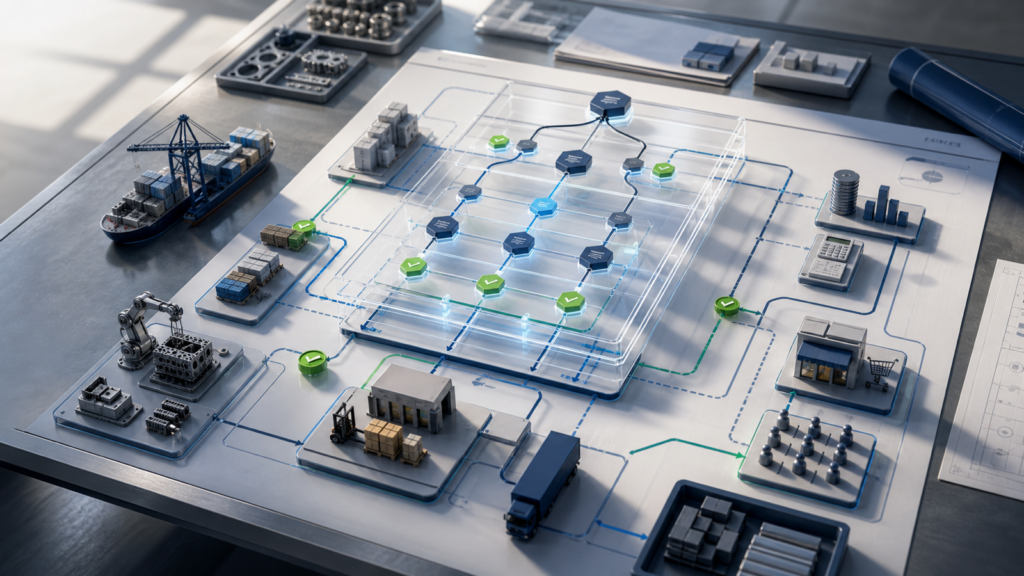
Imagine the same supplier problem comes back for the third time this quarter.
The shipment is late again. Inventory is tight again. A customer order may slip again. The team knows there is a playbook somewhere, but it is not really in the ERP, not in the planning system, and not in the spreadsheet someone updated last month. It is partly in the systems, partly in the messages, and mostly in the memory of the people who handled it last time.
This is the problem most AI demos skip. AI can help summarize the situation, draft an email, or recommend an action. But if the company does not capture why the last decision was made, what tradeoff was accepted, who approved it, and whether it worked, then the company gets faster without getting much smarter.
For industrial companies, the real asset is not just the data. It is the memory of how good decisions get made under pressure.
It is also the reason Kimaru has built Decision Models.
The Problem Is That AI Can Act Faster Than Companies Can Learn
Agents are getting better at action. They can gather information, summarize exceptions, draft responses, query systems, route work, and recommend next steps. In many companies, coordination work that used to take days will soon take minutes.
The harder question is what happens when that work touches real constraints.
Imagine a familiar supply-chain fire drill. A supplier shipment is late, inventory is tight, and an important customer order may miss its delivery date. The ERP can show the purchase order. The planning system can show the forecast. The warehouse system can show inventory. The transportation system can show the lane. Finance can show margin. Every system has a useful fact, but none of them owns the full decision.
Someone still has to decide whether to expedite freight, move inventory from another location, change the production schedule, split the order, call the customer, or accept a margin hit to protect the relationship. That decision may depend on things that are hard to see in a dashboard. A planner may know the supplier is usually reliable even though this shipment is late. A customer lead may know the order matters more than its immediate revenue. A plant manager may know a capacity constraint is real, but workable this week. A procurement lead may know the cheapest alternative will create a larger problem next month.
Those details are part of the decision. They explain why experienced operators sometimes reject the clean-looking answer and choose the answer the business can actually stand behind.
Most companies still do not capture that reasoning in a reusable way. They resolve the exception, move the shipment, update the spreadsheet, send the email, and carry the lesson forward only in the memory of the people who were there. The next time the same pattern appears, the organization has data again, but not always memory.
That is the gap agents expose. As execution gets faster, the cost of weak decision memory goes up.
Nadella’s Warning Is Really About Decision Ownership
Business Insider’s coverage of recent comments from Satya Nadella, Microsoft’s CEO, summarized his concern as a warning about a highly concentrated AI ecosystem. In plain terms: if a small number of AI companies become the place where corporate knowledge accumulates, then the rest of the economy may become dependent on systems it does not control.
The globalization analogy matters here because many companies once outsourced production capacity and later discovered they had also outsourced practical knowledge. AI creates a similar risk at the level of analysis and coordination. A company can hand more work to outside AI systems and later discover that the learning around those activities no longer belongs to the company in a useful form.
The right conclusion is to use the best AI available while being very deliberate about where the company’s own learning accumulates.
In industrial operations, the most important learning often happens in moments like the late supplier example. It is the human reasoning around why one path was chosen over another, which constraints mattered, which risks were accepted, and what the company learned after the outcome was visible. If that learning lives only in chat histories, meeting notes, or a third-party assistant’s memory, the company may become faster while the knowledge behind the work becomes harder to own.
That layer is what Kimaru calls a Decision Model.
A Decision Model is the company’s owned representation of a recurring operational decision. It captures the evidence considered, the constraints applied, the alternatives simulated, the judgment added by people, the approval path, the action taken, the outcome measured, and the learning that should carry forward. Put more simply, it is how the company remembers how to decide.
Context Graphs Belong Inside World Models
The Context Graph article by Jaya Gupta and Ashu Garg is useful because it names something enterprise operators already feel. Most business software stores the current facts: the order, the supplier, the shipment, the invoice, the ticket, the inventory level. Agents need more than those facts. They need the story of how work unfolded.
Context graphs help preserve that story. They capture what happened, what changed, who touched it, which exception mattered, why a workaround was chosen, who approved it, and what happened afterward.
Kimaru has already written about the next layer in 「左脳の罠:エンタープライズAIにLLMだけでは不十分な理由」. Enterprise agents do not only need context. They need World Models: grounded representations of constraints, feasible actions, risk, causality, and likely outcomes.
Dr. Lorien Pratt made this point recently by endorsing Volodymyr Pavlyshyn’s argument that context graphs alone are too narrow. Enterprise agents need institutional memory, specialized World Models by domain, guardrails, and a causal layer that keeps decisions explainable at scale.
For industrial companies, this is practical. A supply-chain World Model has to understand inventory, supplier reliability, production capacity, freight constraints, customer priority, margin pressure, service risk, and the human judgment that determines which tradeoff the business can live with.
This is where Kimaru’s architecture becomes important. Kimaru’s advantage is networked, federated Decision Models.
Networked means Kimaru connects related decisions. A supplier delay is not only a procurement issue. It can affect production, inventory, freight, customer commitments, margin, and working capital. Kimaru connects those decisions so the company can see the ripple effects instead of solving each exception in isolation.
Federated means each customer keeps control of its own data. Kimaru does not ask companies to put sensitive supply-chain data into a shared pool. ERP data, supplier records, inventory, production plans, and customer commitments stay in the customer’s own environment.
The network gets smarter from patterns and archetypes, not from exposing customer data. No customer sees another customer’s information. Kimaru learns which kinds of decisions tend to repeat, which risks usually matter, which tradeoffs appear again and again, and which questions humans need to answer before action is safe.
A Decision Model can include context graphs, orchestration, harnesses, data connectors, ontology, human judgment, and causal simulation. Those pieces become strategically useful when they are organized around recurring decisions.
For supply chain, that means a network of World Models mapping how the global supply chain actually behaves.
That kind of memory becomes more valuable as agents become more capable. If an agent is helping summarize an email, weak grounding is annoying. If an agent is recommending an operational action that affects inventory, margin, service levels, or production, weak grounding becomes a real business risk.
Gartner’s Decision Stack Is Becoming Real
Gartner has been describing a similar shift in the language of autonomy. In its 2026 supply-chain research, Gartner argues that data platforms alone are not enough for autonomous operations. Autonomy requires a decision stack that combines data, workflows, governance, and human context.
A decision stack is the layer of software and process that helps a company make, approve, execute, and learn from important decisions. It is the part that sits between raw information and action.
Gartner also forecasts that supply-chain software with agentic AI will grow from less than $2 billion in 2025 to $53 billion in spend by 2030. The number matters because it shows how quickly this market is moving. The operating-model point matters more because many agent deployments will disappoint unless companies redesign the decision layer underneath them.
Autonomy in supply chain is not a single switch. Some decisions should be automated. Some should be recommended. Some should be supervised. Some should be escalated immediately because the consequence, uncertainty, reversibility, or accountability requirement is too high. A useful system has to know the difference.
David Pidsley’s Gartner profile sits directly in this territory: analytics, data science, emerging analytics trends, and Decision Intelligence. The practical issue is human decision making at scale. As AI gets better at producing answers, organizations need better ways to decide which answers can be trusted, which require review, and which should change how the company acts next time.
For Kimaru, those requirements are product architecture. Decisions need to be explicit. Context needs to be preserved. Human judgment needs a governed place in the loop. Outcomes need to be measured. Learning needs to become reusable. Over time, companies should be able to move from assisted decisions to supervised decisions to conditional autonomy, but only where the pattern, confidence, reversibility, and accountability requirements support it.
Copilots Are Useful, But They Are Not the Decision Layer
Microsoft Copilot is important because it shows how quickly AI will become part of ordinary enterprise work. Microsoft positions Copilot around Microsoft Graph and the Microsoft 365 applications where knowledge workers spend much of their day: Word, Excel, PowerPoint, Outlook, and Teams. For drafting, summarizing, meeting preparation, spreadsheet analysis, and personal productivity, that is a powerful surface area.
Industrial decisions pass through documents and meetings, but they cut across ERP, planning, procurement, logistics, finance, quality, warehouse, customer, supplier, and production systems. They require an understanding of constraints, authority, reversibility, risk, service impact, margin impact, and the cost of being wrong.
Copilot can help a person reason over information. A Decision Intelligence Platform has to manage the decision as an operating object. It has to preserve context, simulate alternatives, govern human approval, create an audit trail, connect to operational systems, and measure what happened afterward. Without that structure, a company can become faster at producing analysis while remaining weak at institutional learning.
This is why I see Kimaru as the governed decision layer general AI tools will increasingly need to plug into. Foundation models will continue to get stronger, and companies should use them. The point is to make sure the company’s own operating knowledge compounds inside a system it controls.
This Is the Practical Side of Organizational Singularity
This is also the natural follow-on to Kimaru’s earlier writing on Organizational Singularity. Peter Diamandis and Salim Ismail have been describing a future where AI-native organizations sense, interpret, decide, act, and learn with much less coordination drag than companies built for the previous era.
In physical operations, that future is already visible. Coordination drag is the late shipment that becomes three meetings. It is the supplier issue that turns into a spreadsheet. It is the production constraint that moves through a chain of approvals. It is the customer exception that everyone discusses but no system remembers in a way that helps next time.
Agents will compress that cycle. The question is whether they compress confusion or improve the decision loop.
The industrial version of Organizational Singularity only becomes useful if speed is connected to judgment. Humans still need to set intent, add tacit context, resolve tradeoffs, approve exceptions, and teach the system through correction. The difference is that their judgment should stop disappearing after the work is done. It should become part of the operating memory of the company.
That is the practical role of Decision Models.
Dr. Lorien Pratt Saw This Coming
The foundation for this is Decision Intelligence.
Dr. Lorien Pratt’s work has long treated decisions as first-class objects: things that can be designed, modeled, governed, improved, and connected to outcomes. In Link: How Decision Intelligence Connects Data, Actions, and Outcomes for a Better World, she frames Decision Intelligence around the chain from data to action to outcome.
The practical idea is straightforward: if organizations can make decisions explicit, they can improve them. A decision does not have to vanish after a meeting or an email thread. It can become something the company studies, governs, reuses, and improves.
That framing is becoming essential for AI. If agents can act, then organizations need a discipline for deciding what action should be taken, why, under what constraints, and how the outcome should improve the next decision.
Dr. Pratt’s second book, The Decision Intelligence Handbook, extends that practical orientation. The important shift is to stop treating decisions as temporary meeting outputs and start treating them as systems that can be designed, modeled, tested, governed, reused, and improved.
Kimaru’s phrase “Decision Models” is a simple way to bring that discipline into operational software. Decision Models are Decision Intelligence made practical for recurring industrial work.
What Kimaru Has Built
Kimaru gives industrial companies company-owned Decision Models.
These models sit above the systems companies already use. They do not replace ERP, planning, procurement, logistics, finance, or quality systems. They connect the signals across those systems into governed decision loops.
Go back to the late supplier example. A Kimaru Decision Model would help the company organize the relevant evidence, compare the realistic options, make the tradeoffs visible, involve the right human approver, record why the action was taken, and measure whether the decision worked. The next time a similar supplier issue appears, the company would not be starting from a blank page.
A Kimaru Decision Model helps the company answer what decision is being made, what evidence matters, what constraints apply, which actions are available, which tradeoffs should be simulated, who needs to approve, what action was taken, what happened afterward, and what the system should learn.
The important point is ownership. The company owns the decision logic. It owns the decision history. It owns the decision receipts. It owns the learning loop. That is how industrial companies can use powerful AI without giving away the operating knowledge they have earned.
The broader Kimaru network makes those models more powerful over time. The network can learn recurring patterns and archetypes in supplier risk, inventory exposure, production constraints, freight disruption, customer-priority tradeoffs, and margin impact. Individual customers keep control of their data. The system still gets better at recognizing the kinds of decisions that repeat across the global supply chain.
As agents spread through the enterprise, this becomes strategic infrastructure. A company that can govern and improve its recurring decisions will not only move faster. It will accumulate a better understanding of how it operates under pressure.
The Future of Work Is a Decision Architecture Problem
The future of work will be defined by whether companies can make better decisions faster while preserving human judgment, operational accountability, and company-owned learning.
Nadella’s warning points to the ownership of learning systems. The Context Graph thesis points to the need for durable work context. The World Models thesis points to grounded simulation and causal understanding. Gartner’s decision stack points to the operating model autonomy requires. Organizational Singularity explains why coordination is being compressed. Dr. Pratt’s Decision Intelligence work gives the foundation for treating decisions as designed systems.
That convergence is why Kimaru’s direction matters. Agentic AI will make action cheaper and faster, but industrial companies still need an owned place where operational judgment accumulates. Without that layer, AI may accelerate work while leaving the reasons behind the work scattered across tools, people, and vendors.
Kimaru has built the other path: networked, federated Decision Models that let industrial operators use AI while preserving the intelligence of the business itself. Context graphs, orchestration, connectors, ontology, agent harnesses, and World Models all matter. The advantage comes from organizing them around governed decisions that learn across the global supply chain.
References
- Satya Nadella, X post on AI learning systems and industry concentration
- Business Insider, coverage of Nadella’s June 2026 warning on AI concentration
- Jaya Gupta and Ashu Garg, AI’s trillion-dollar opportunity: Context graphs
- Kimaru, 「左脳の罠:エンタープライズAIにLLMだけでは不十分な理由」
- Dr. Lorien Pratt, LinkedIn post on World Models and enterprise agents
- Volodymyr Pavlyshyn, LinkedIn post on institutional memory and World Models
- Gartner, Three building blocks for an autonomous supply-chain future
- Gartner, Agentic AI in supply-chain software forecast
- David Pidsley, Gartner expert profile
- Dr. Lorien Pratt, Link: How Decision Intelligence Connects Data, Actions, and Outcomes for a Better World
- Dr. Lorien Pratt, The Decision Intelligence Handbook
- Microsoft, Introducing Microsoft 365 Copilot
- Peter Diamandis and Salim Ismail, Organizational Singularity discussion
お問合せ
You can’t afford another quarter of static planning. The global supply chain is now exposed to global shocks – tariffs, port delays, labor volatility – that demand fast, structured responses.
Kimaru gives you a real decision layer on top of the tools you already use. Not just a system of record – a system of action.
If your team is buried in reactive firefighting, this is the fix.
Request a 30-minute demo to see what Kimaru’s agents would recommend on your actual data – and how much time and margin you could get back.
 日本語
日本語  English