
Kimaru product
Decision Operating System for Supply Chains.
Improve the recurring decisions that control cost, revenue, service, and continuity.
Kimaru brings together what your systems show, what your people know, and what AI recommends. It models what drives the result, compares realistic choices before you commit, routes the decision to the right person, and records what happened so the next comparable decision starts smarter.
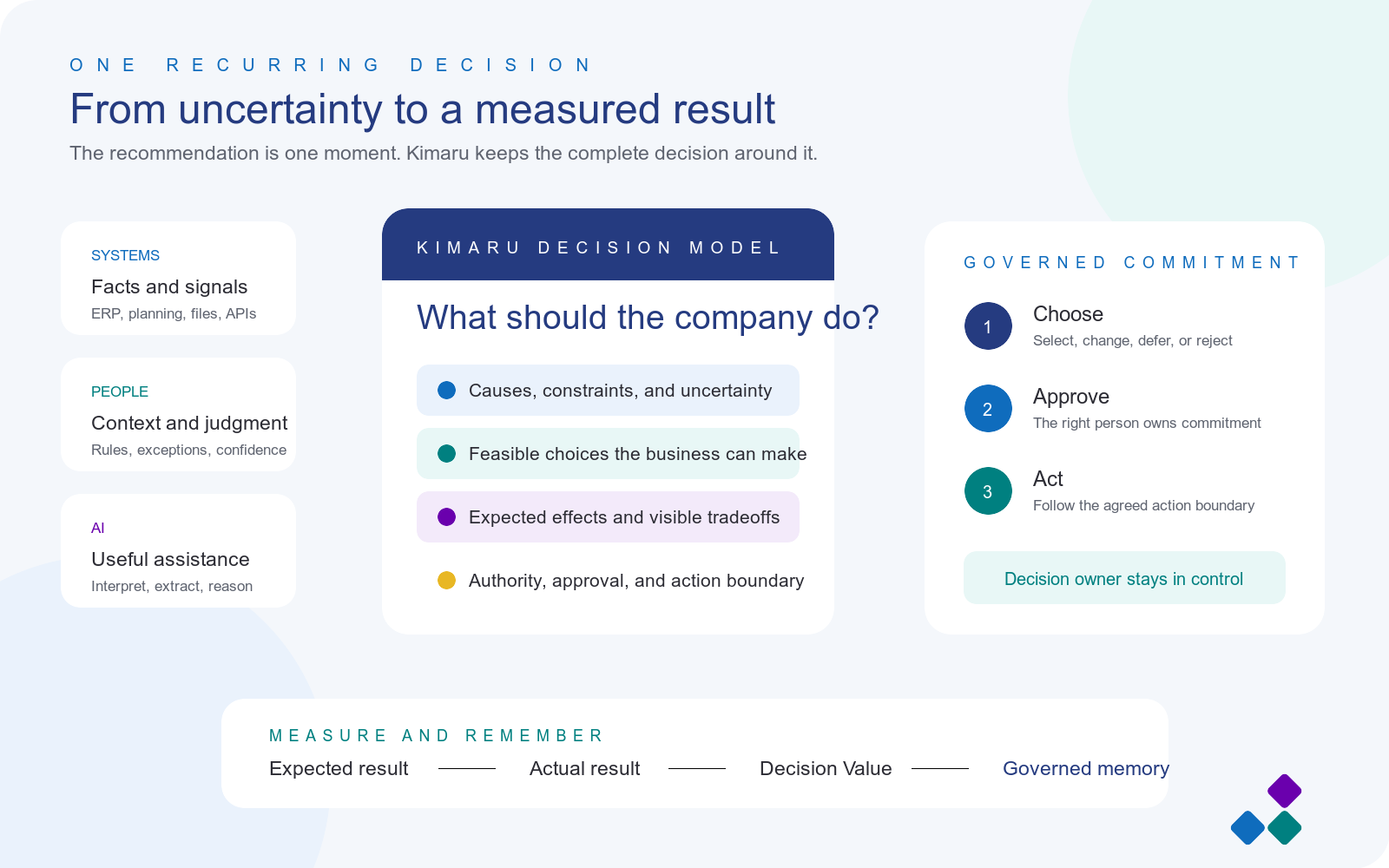
Three different jobs
A recommendation is not a decision system
An AI answer can be useful. An automated action can save time. But a recurring company decision also needs evidence, employee context, realistic choices, tradeoffs, authority, an observed result, and a memory of what worked.
Copilot or agent
Handles the request
Answers a question, recommends an action, or performs a task.
Agent harness
Connects the tools
Connects AI to data and systems, routes work, and controls access.
Kimaru Decision Model
Keeps the decision together
Preserves what the company knew, what it could do, who committed, what happened, and what it should remember.
A helper can suggest an answer. Kimaru helps the company make the decision and learn from the result.
The product loop
One Decision Model, start to finish
The product is not a single screen. It is the complete path from a hard recurring choice to an observed outcome and reusable decision memory.
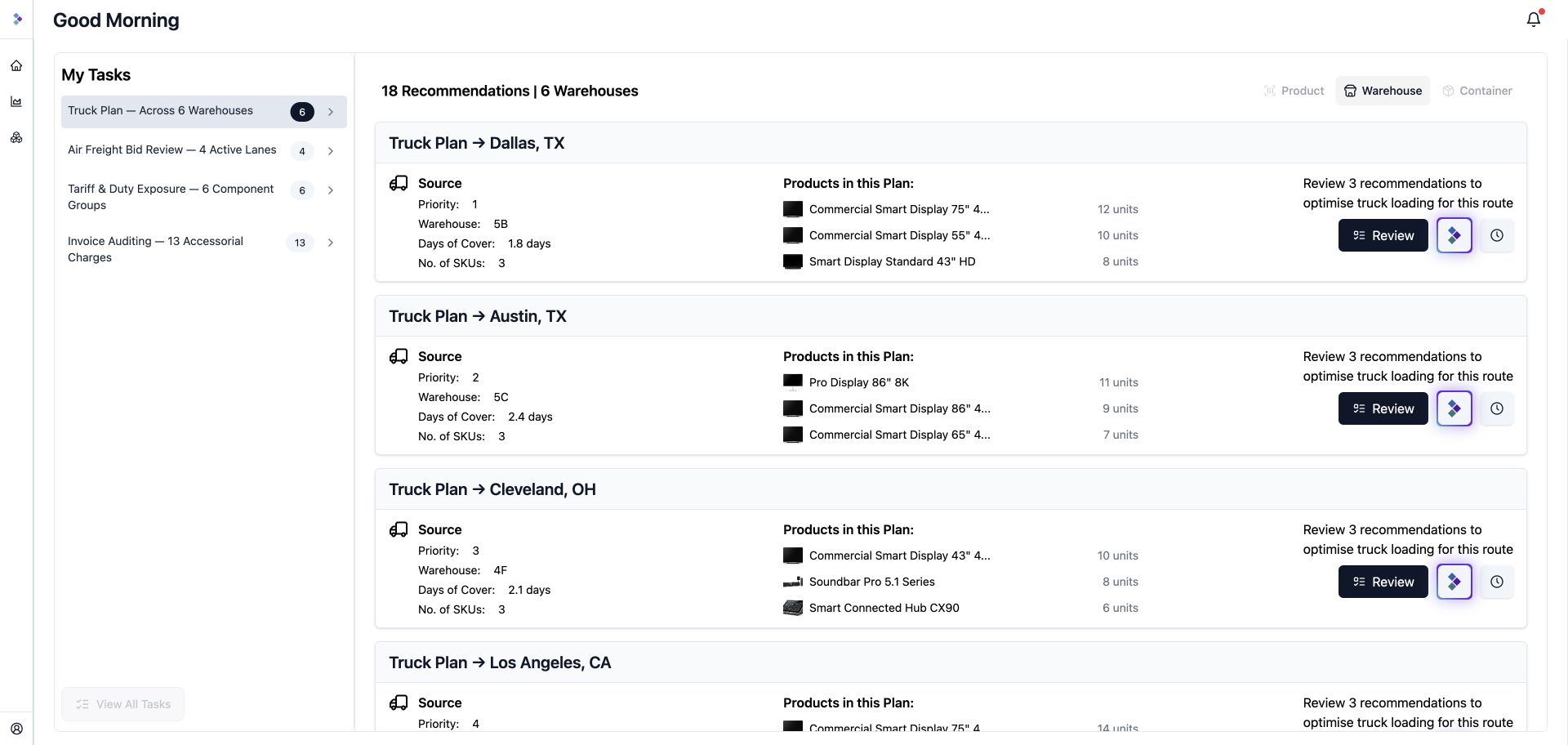
Frame
Start with one decision
Name what the company has to decide, who owns the commitment, which constraints matter, and how the result will be judged.
Examples include what to build, what to buy, where to move constrained inventory, which supplier response to choose, which order to protect, or when to escalate an exception.
Work Hub: The team sees recurring decisions that need attention, not another general chat window.
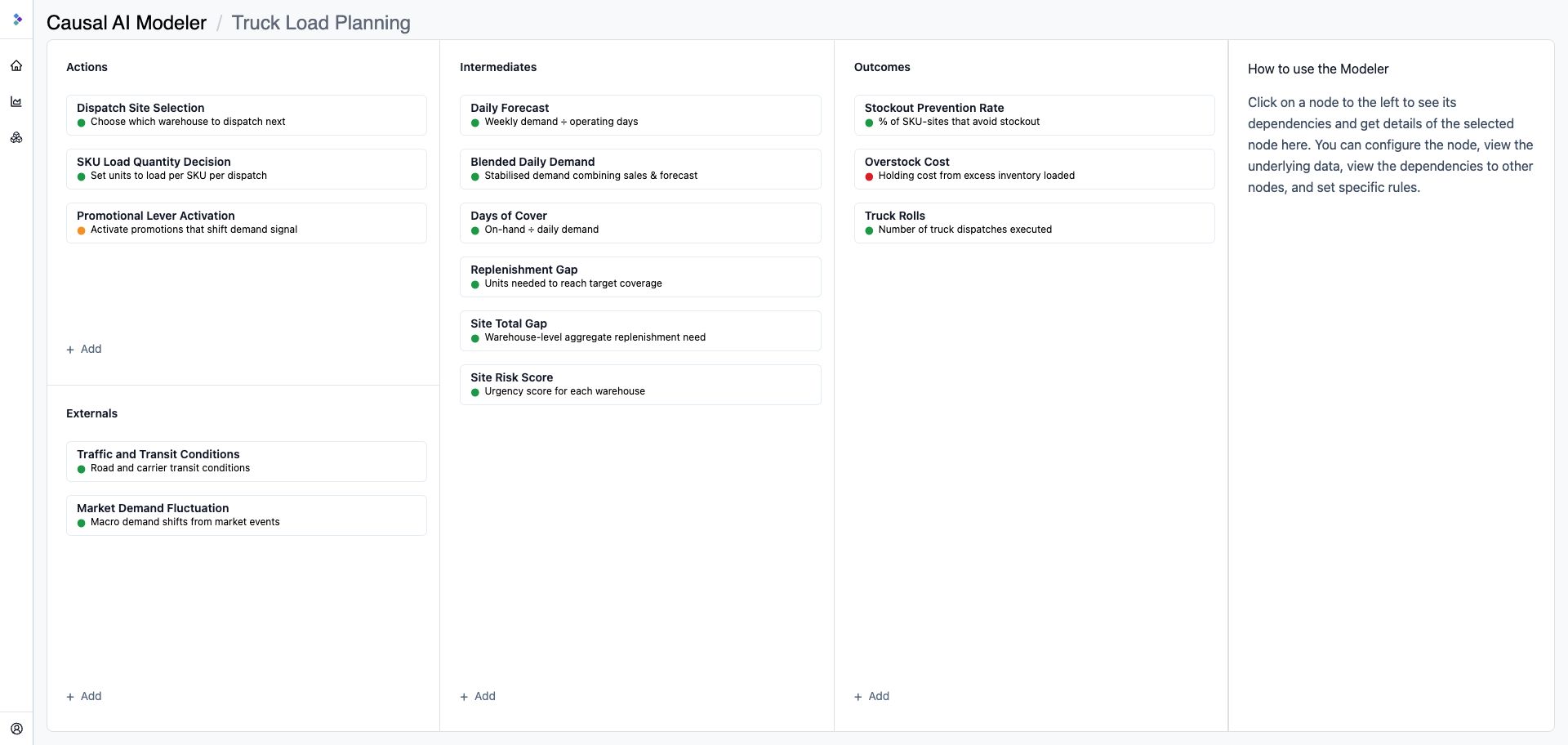
Model
Show what drives the result
Kimaru connects controllable actions, outside conditions, intermediate effects, and business outcomes in a causal Decision Model.
The logic is visible. The team can see how material readiness, capacity, lead time, demand, cost, service, risk, or other factors influence the outcome before it chooses.
Causal AI Modeler: Actions, external conditions, intermediate effects, and outcomes stay visible in one decision structure.
Compare
Keep realistic choices visible
Kimaru keeps more than one feasible route alive long enough to compare likely consequences and tradeoffs. The first recommendation is not treated as automatically correct.
The decision owner can examine how choices affect cost, service, capacity, timing, risk, and other agreed objectives before the company commits.
Decision Review: Feasible recommendations and the evidence behind them are reviewed before a route is selected.
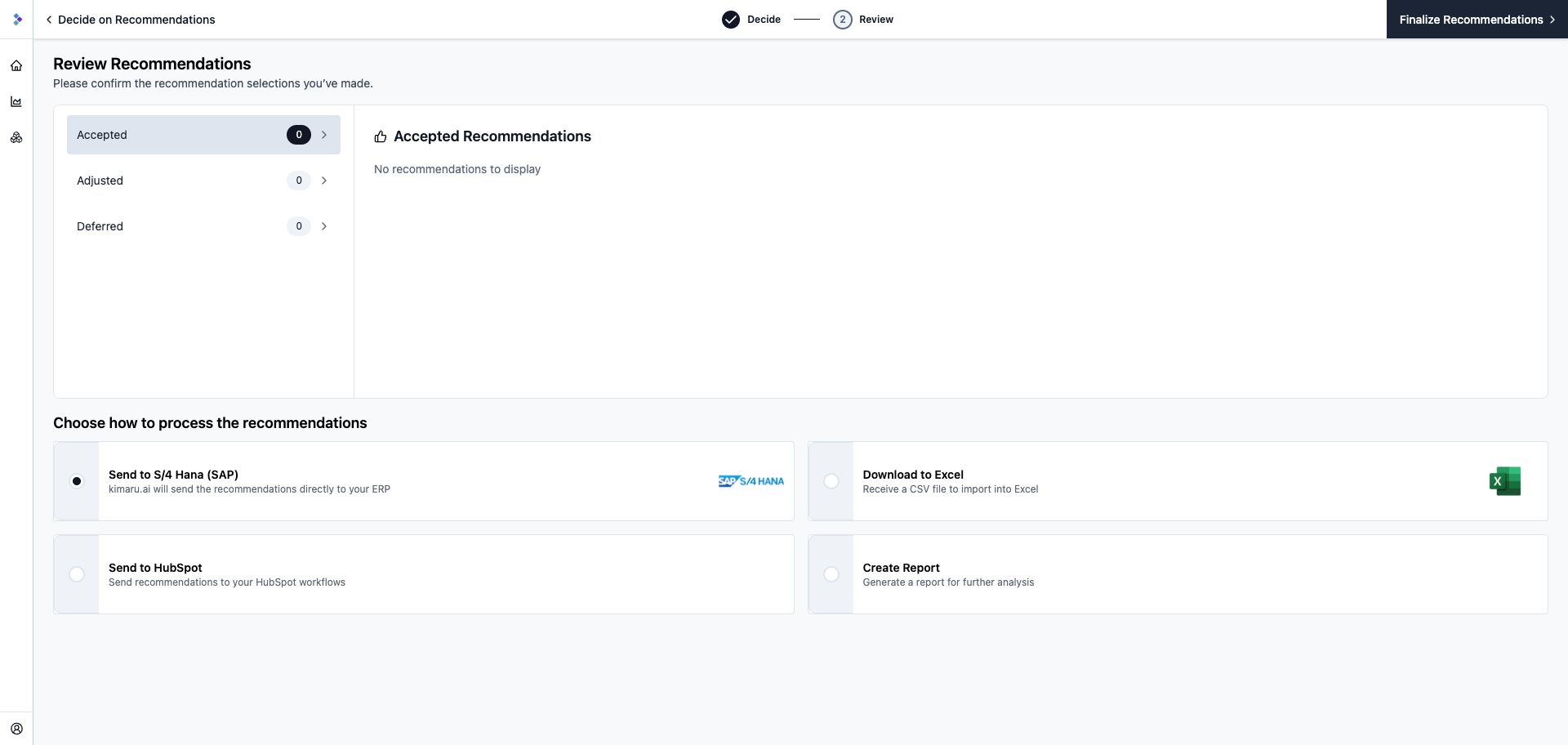
Commit
Put the decision with the right person
The named decision owner can approve, adjust, defer, reject, or escalate. Human judgment remains inside the decision, including the reason for an override or change.
Any system write-back or external action follows the agreed integration, customer authorization, and approval rules.
Governed approval: The person with authority controls the commitment and how an approved result is passed to existing systems.
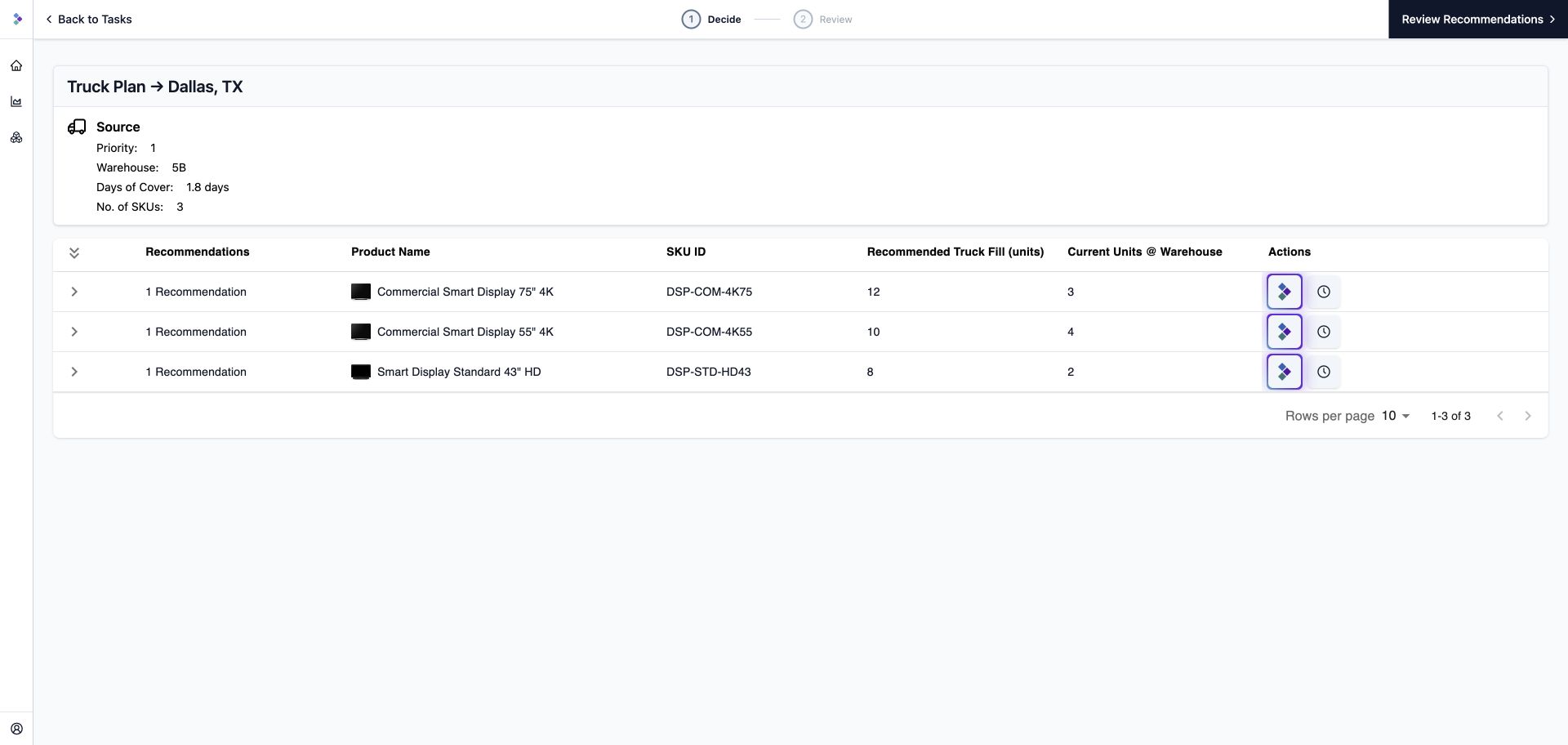
Measure
Compare the prediction with reality
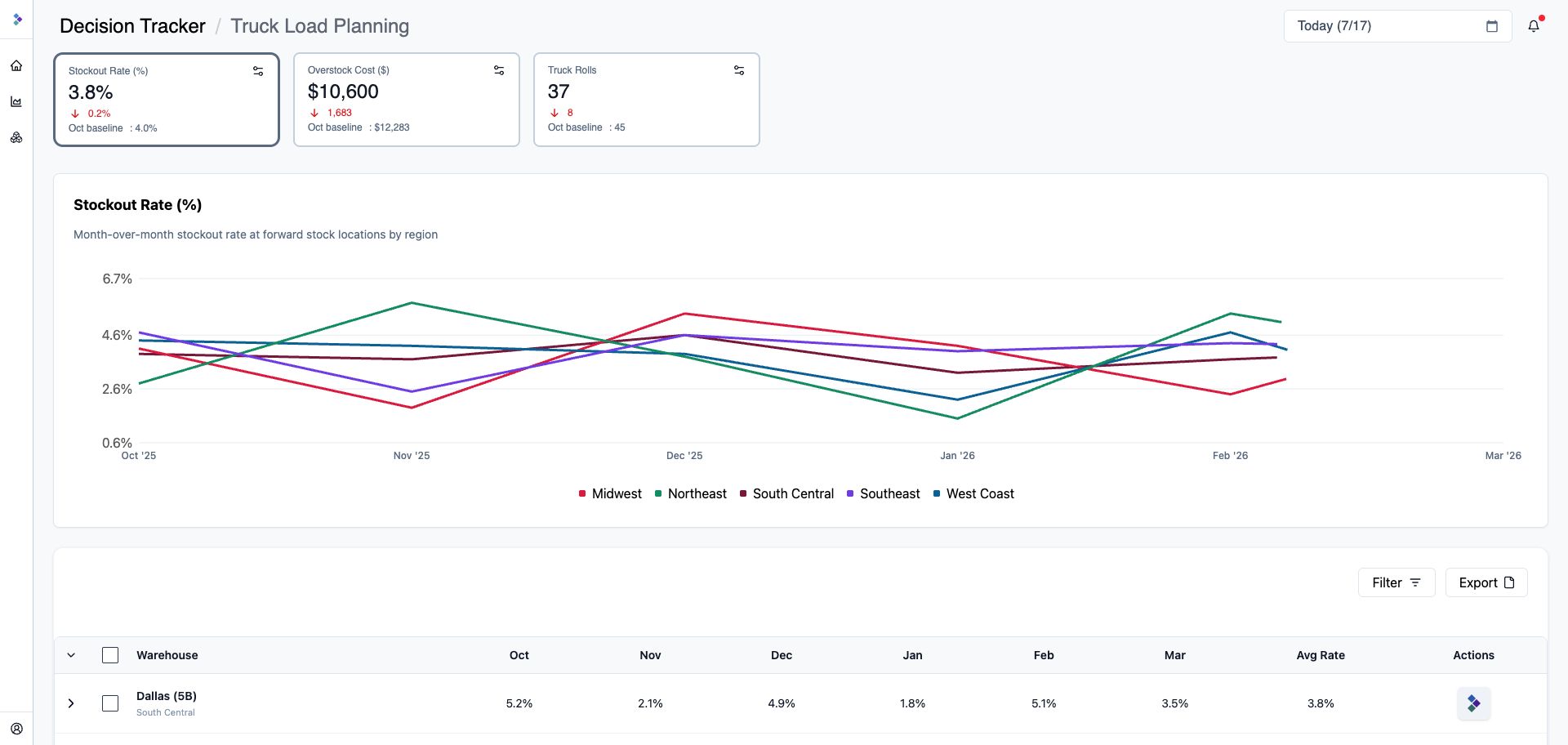
Kimaru records the evidence, recommendation, approval or override, expected result, actual result, and variance. Where evidence supports attribution, it can calculate or estimate Decision Value using the agreed baseline.
One result does not become permanent truth automatically. Useful learning is retained, revised, or retired through governance.
Decision Tracker: The next comparable decision begins with more useful, outcome-linked context.
The product object
What is inside a Decision Model?
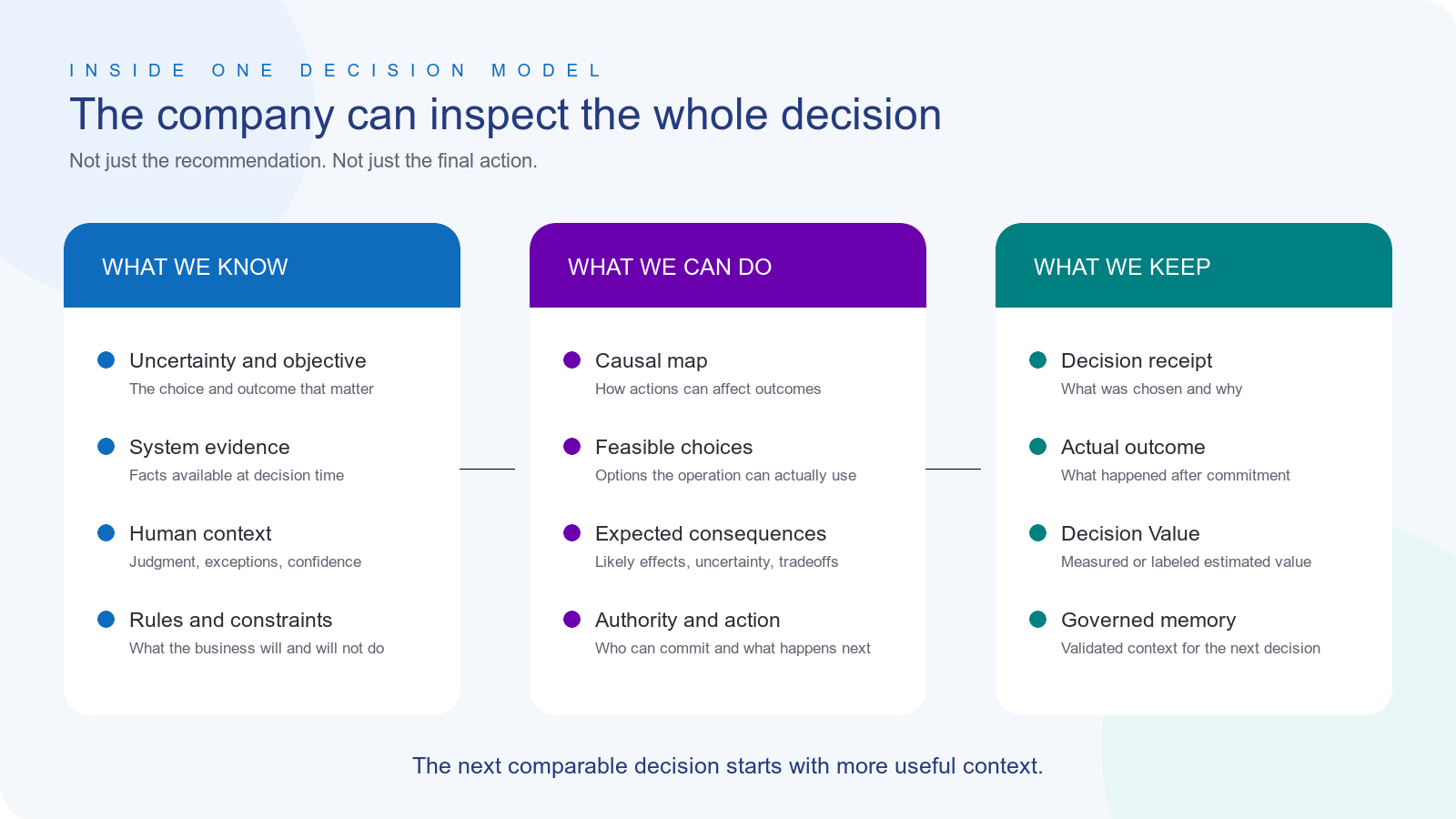
A Decision Model is the reusable operating model for one recurring choice. It keeps the whole decision episode inspectable, including what the company knew, what it could do, who committed, what happened, and what governed learning should be used next time.
Supply-chain wide
Built for recurring decisions, not one feature menu
Kimaru is not a pricing tool or an inventory module. It is the decision layer for recurring choices that cross systems, teams, and objectives.
Production and capacity
Which feasible schedule should the company run when material, machine, labor, priority, and customer commitments do not line up?
Procurement and supplier response
Should the company buy, wait, expedite, substitute, transfer, renegotiate, or escalate when timing, cost, quality, and continuity conflict?
Inventory and allocation
Where should constrained stock go, and which revenue, service, working-capital, or risk tradeoff is acceptable?
Logistics and delivery
Which movement, warehouse, route, or delivery choice best protects timing and downstream operations under current constraints?
Customer commitments
What can the company promise when supply, capacity, inventory, and delivery evidence conflict?
Cross-functional exceptions
Which issue needs action now, which can wait, who owns the commitment, and what outcome will show that it was resolved well?
Works across the stack
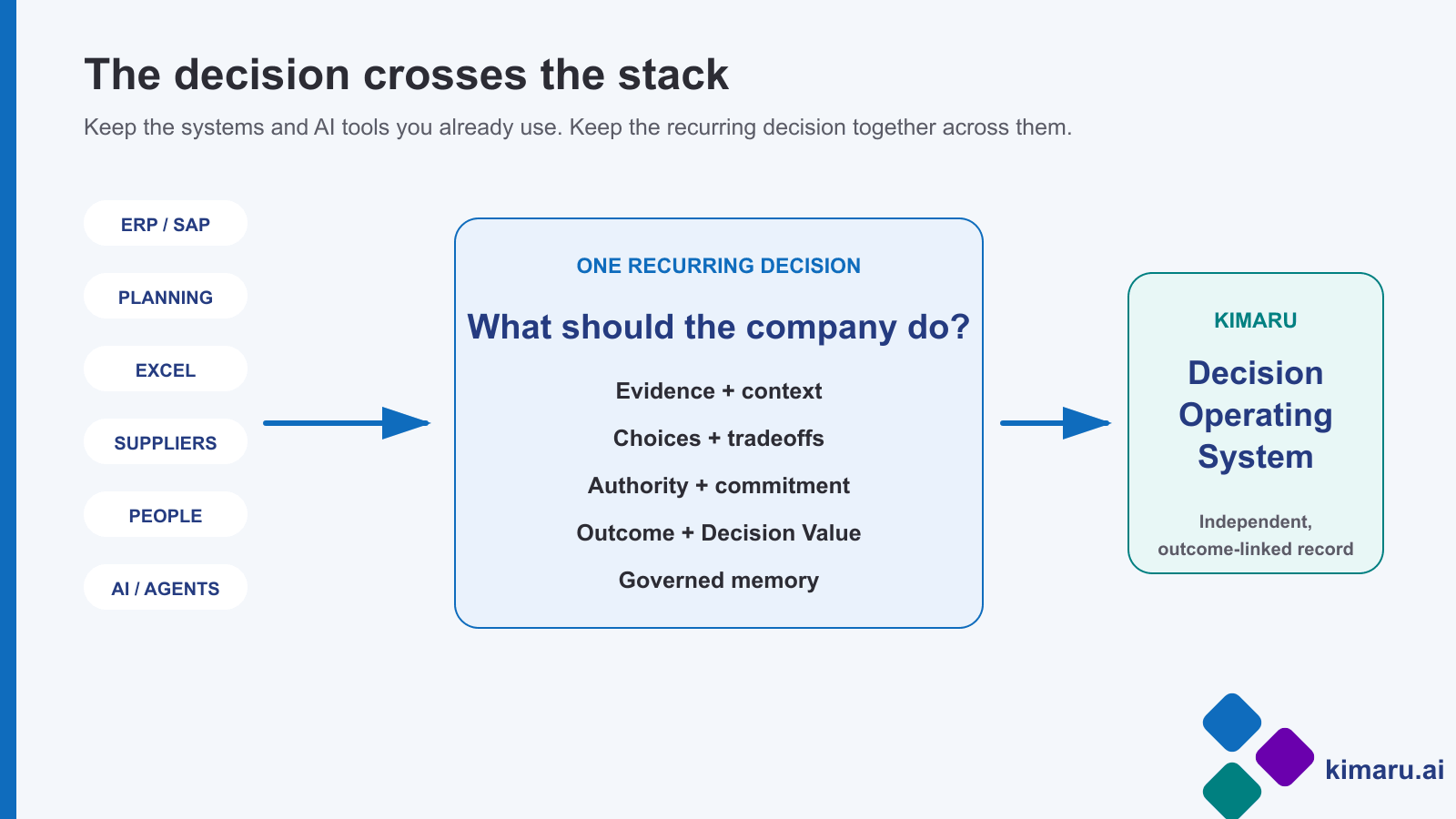
Keep the systems and AI tools you already use
Keep SAP, Microsoft, Oracle, and the tools you already use. Kimaru keeps the recurring decision together when it crosses them.
ERP remains the system of record for transactions. Planning tools, spreadsheets, data platforms, copilots, models, and agents can continue doing the work they do well. Kimaru sits above and across them as the independent, outcome-linked decision layer.
External AI models can assist with interpretation, extraction, or reasoning. The evidence, authority, outcome, and history remain in the Kimaru decision layer within the agreed deployment and governance boundary.
If one existing suite already handles the complete decision, required human context, authority, outcome tracking, and continuous improvement well, Kimaru may not be needed.
Expand decision by decision
Start with one decision. Add more. Keep what the company learns.
The first Decision Model should solve a bounded, high-value operating problem. Adjacent models can then connect decisions that influence one another.
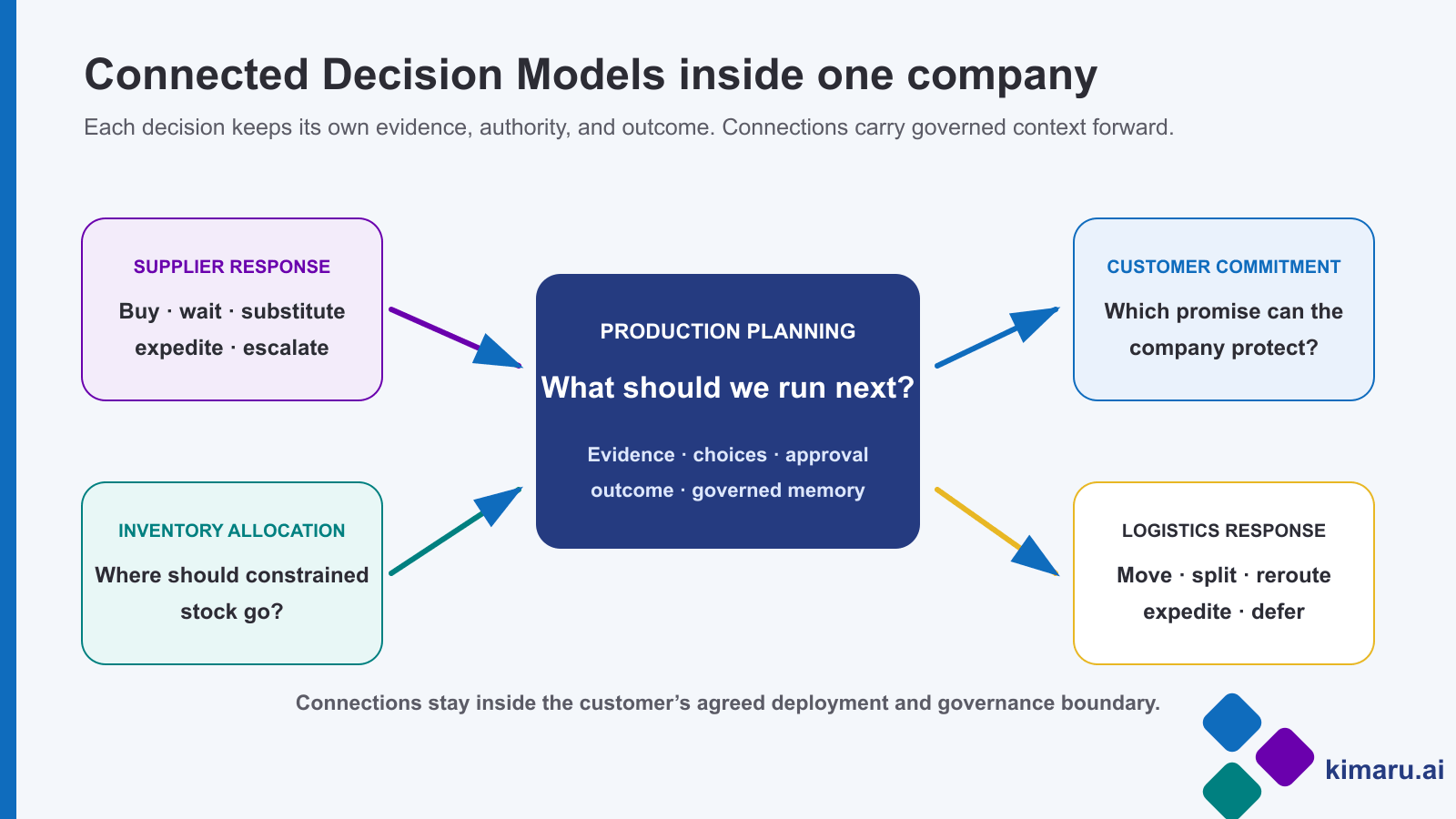
- A supplier-response model identifies a material constraint.
- A production-planning model compares feasible schedules.
- An inventory-allocation model protects the right downstream demand.
- A customer-commitment model makes the service tradeoff explicit.
Each model keeps its own evidence, authority, and outcome. Governed connections carry relevant context forward so the next decision does not start from zero.
Measured customer proof
One production-planning decision created measurable value
Wilton Weavers
Wilton Weavers used Kimaru for aircraft-carpet production planning, where ERP data had to be reconciled with material readiness, loom compatibility, lot-mixing rules, capacity, and planner judgment.
Kimaru did not replace Wilton's ERP or planners. It made one difficult recurring decision visible, reviewable, measurable, and reusable.
Read the Wilton decision story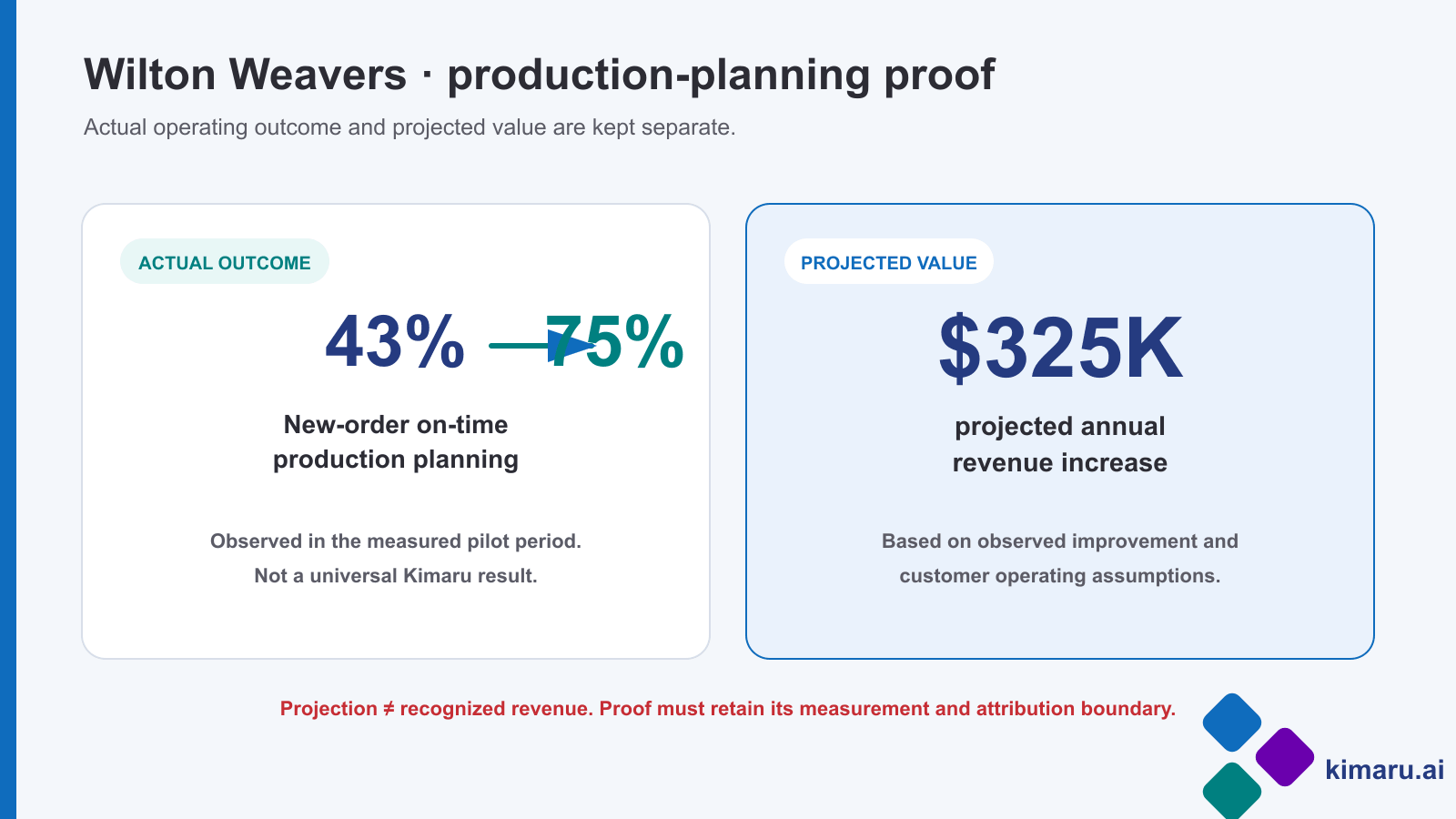
Deployment and control
The boundary fits the decision
Kimaru can be configured for customer-managed AWS, a private Kimaru-managed tenant, or an agreed on-premises or private-cloud design. The actual data location, controls, external model use, and responsibilities depend on the deployment that is contracted and implemented.
Teams can begin in assisted decision mode with people fully in control. Any later supervised or conditional action depends on agreed confidence, risk, and approval boundaries.
Review Trust & Security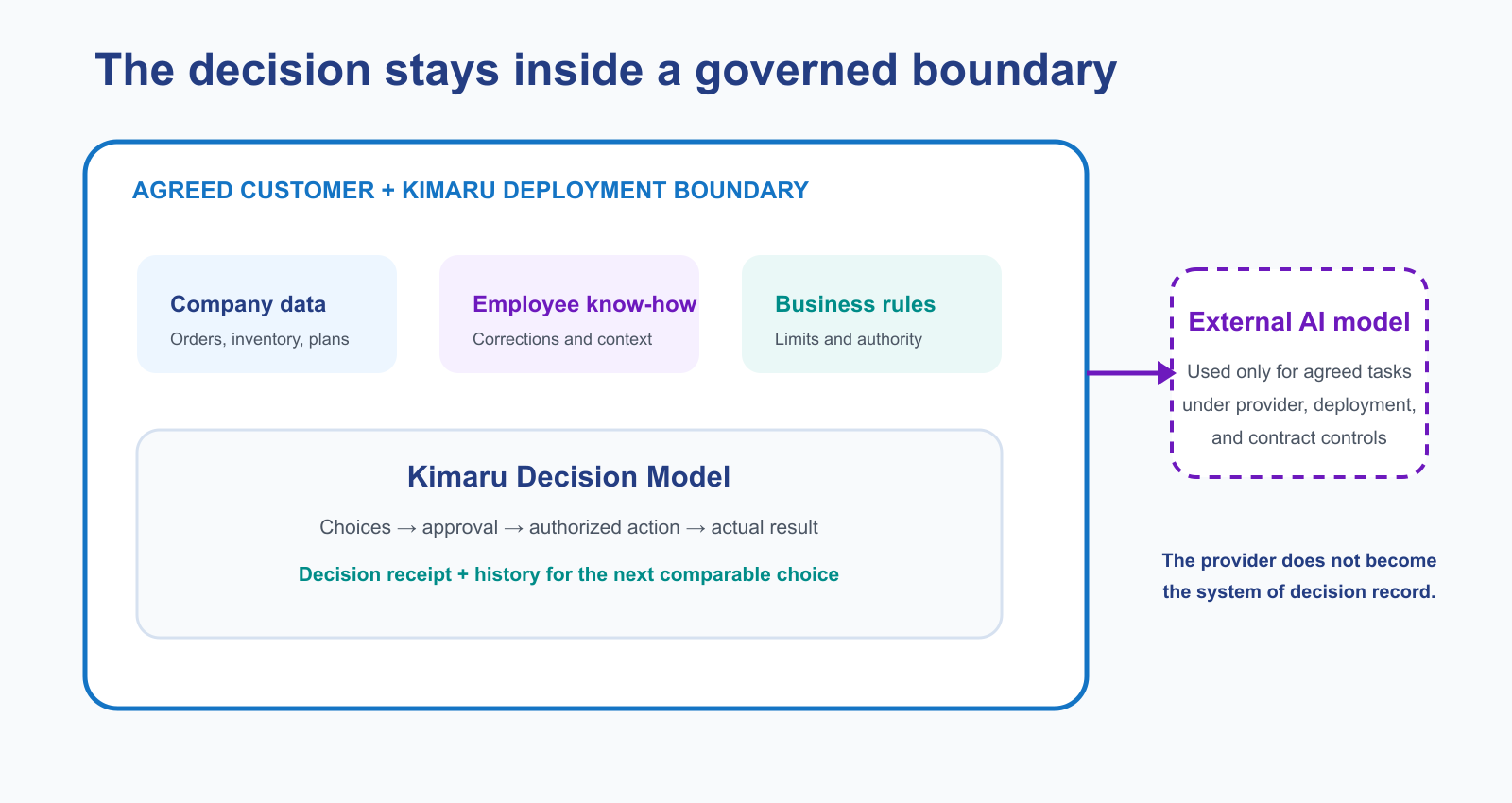
A bounded first step
Start small enough to prove it
Choose a recurring decision where delay or error has a measurable consequence, evidence is split across tools or people, human judgment changes the right answer, a named person owns the commitment, and the outcome can be observed in a useful time window.
A proof of value can begin with controlled files, read-only database views, or scheduled API pulls. It does not require write-back.
Start with the decision
Which recurring decision is costing you the most?
Bring one hard decision, the people who make it, and the outcome you need to improve.
 日本語
日本語  English